September 16, 2026
Odoo vs Salesforce CRM: Which Is Right for Your Dubai Business?
Milaaj Editorial / Research Insights
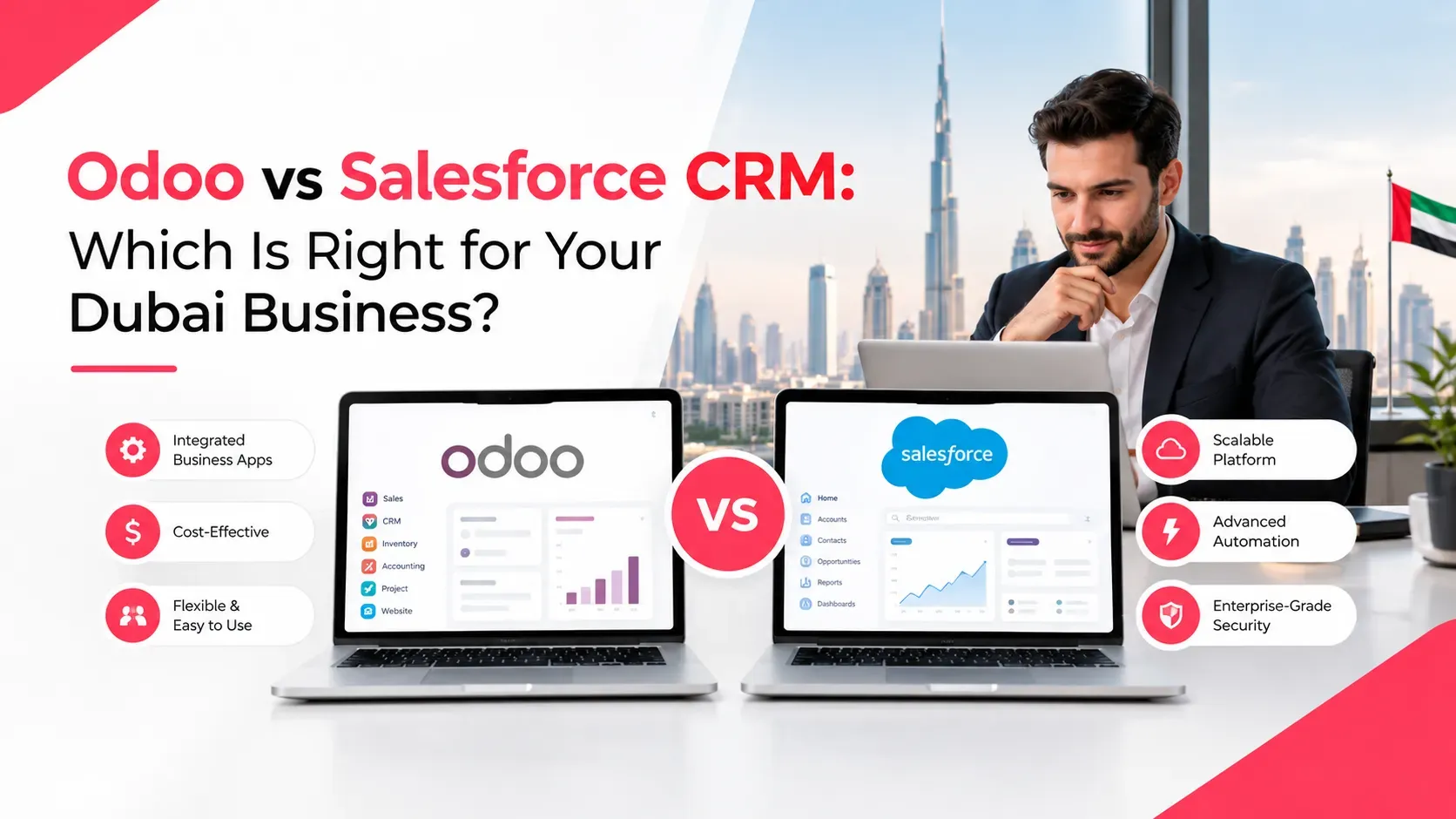
You've probably had a Salesforce rep quote you a number that made you wince, and then wondered if Odoo's much cheaper price tag means you'd be getting a lesser tool.
That's the exact comparison most Dubai business owners get stuck on. One platform is the global name everyone recognizes, and the other is the one your developer keeps recommending because it does more for less.
Both are genuinely capable CRMs. The right one for you depends less on which is "better" and more on how your business actually operates.
Quick Answer
Salesforce is a powerful, enterprise-grade CRM with deep customization and a huge app ecosystem, but it comes at a premium price and takes longer to implement well. Odoo bundles CRM with a full suite of business apps like accounting, inventory, and HR at a fraction of the cost, making it the stronger fit for most small and mid-sized Dubai businesses that want an all-in-one system rather than a CRM alone.
Key Takeaways
- Salesforce is a dedicated, best-in-class CRM platform with extensive third-party integrations and enterprise-grade support.
- Odoo combines CRM with ERP functions like accounting, inventory, and HR in one connected system, often at a much lower total cost.
- Salesforce pricing scales per user and per feature tier, which adds up quickly for growing teams.
- Odoo's open-source Community edition is free, while the Enterprise edition adds premium features and support at UAE-friendly pricing.
- The right choice depends on whether you need a specialized CRM or a connected business management system that includes CRM as one piece.
What Is Odoo CRM?
Odoo CRM is one module within Odoo, an open-source suite of business apps that includes CRM, accounting, inventory, HR, e-commerce, and more, all built to work together on one platform.
Odoo is available in two editions. The Community edition is free and open-source, while the Enterprise edition adds advanced features, cloud hosting, and official support. For a UAE business, this means you can start small with just the CRM module and add other apps like accounting or inventory later, all on the same connected system. If your business already runs on a mix of ERP tools, it's worth seeing how full ERP solution development fits alongside a CRM decision like this one, since the two are rarely separate conversations for long.
What Is Salesforce CRM?
Salesforce is a cloud-based platform built specifically around customer relationship management. As Salesforce itself describes it, essential CRM features include contact management, sales pipeline tracking, customer service tools, marketing automation, and AI-powered insights, all designed to give a business a complete view of its customers.
Salesforce is organized into different "clouds" (Sales Cloud, Service Cloud, Marketing Cloud, and more), which businesses can mix and match depending on their needs. It's widely considered one of the most feature-rich CRMs on the market, with a massive ecosystem of third-party apps through its AppExchange marketplace.
Odoo vs Salesforce: The Key Differences
The core difference is scope and cost. Salesforce is a specialized, feature-dense CRM with a premium price point, while Odoo bundles CRM with a full suite of connected business apps at a significantly lower cost, making it better suited to businesses that want more than just customer management from one system.
Pricing and Licensing
Salesforce charges per user, per month, with pricing that climbs quickly once you add features or move to higher tiers. Odoo's Community edition is free, and its Enterprise pricing is generally far more affordable per user, especially once you factor in that it replaces multiple separate tools.
Customization and Flexibility
Salesforce offers deep customization through its own development language and a vast partner ecosystem, but this usually requires specialized (and costly) Salesforce developers. Odoo is open-source, so its code can be modified directly, and its modular app structure makes it straightforward to add or remove functionality as your business changes.
Ease of Implementation
Salesforce implementations, especially with heavy customization, can take months and typically need certified consultants. Odoo implementations are often faster for small and mid-sized businesses, particularly when only a handful of modules are needed at launch.
Scalability for Growing Businesses
Both platforms scale well, but they scale differently. Salesforce scales by adding more specialized clouds and licenses, which increases cost steadily. Odoo scales by adding more connected apps under the same system, often at a more predictable and lower ongoing cost.
Local UAE Support
Salesforce support in the UAE typically comes through certified implementation partners rather than direct enterprise contracts for smaller businesses. Odoo has a strong base of regional partners in Dubai who handle implementation, customization, and UAE-specific needs like VAT and corporate tax configuration.
Odoo vs Salesforce Pricing in the UAE: What to Actually Expect
Salesforce pricing in the UAE typically starts higher per user per month for its entry-level CRM tier, and costs rise significantly once you need advanced automation, reporting, or additional clouds. Odoo's Community edition costs nothing to license, and its Enterprise pricing is usually a fraction of Salesforce's per-user cost, particularly once you compare the total cost of running CRM, accounting, and inventory as separate Salesforce-plus-other-tools versus one connected Odoo system. If you're also comparing Odoo against other ERP platforms, it's worth reading how the numbers stack up in our breakdown of Odoo vs SAP for the Dubai mid-market, since a lot of the same pricing logic applies here.
When Salesforce Is the Better Fit
Salesforce tends to make more sense when:
- Your business is enterprise-scale with a dedicated sales operations team.
- You need deep, specialized CRM features like advanced lead scoring or complex sales forecasting.
- You're already integrated with a large ecosystem of tools that connect natively to Salesforce.
- Budget isn't the primary constraint, and you value having the most widely recognized CRM brand.
When Odoo Is the Better Fit
Odoo tends to make more sense when:
- You want CRM combined with accounting, inventory, HR, or e-commerce in one connected system.
- You're a small or mid-sized business that needs strong functionality without enterprise-level costs.
- You want the flexibility to customize the platform directly or add modules as you grow.
- You need UAE-specific features like VAT-compliant invoicing without extra add-ons.
If this sounds closer to your business, it's worth having a proper Odoo implementation scoped out for your specific modules and workflows, rather than guessing at what you'll actually need on day one.
Switching or Migrating Between the Two: What to Know
Moving from Salesforce to Odoo, or the other way around, isn't a simple export-import job. Customer records, pipeline stages, custom fields, and automation rules all need to be mapped carefully to avoid data loss.
If you're currently juggling several disconnected tools alongside Salesforce or an older CRM, it's also worth understanding how a broader platform migration works, since the same planning principles apply whether you're consolidating CRM, accounting, or inventory. Our guide on migrating from Zoho and Tally to Odoo for UAE corporate tax compliance walks through a similar consolidation process in detail.
Frequently Asked Questions
Is Odoo cheaper than Salesforce?
Generally, yes. Odoo's Community edition is free, and its Enterprise pricing is typically much lower per user than Salesforce, especially when you account for Odoo replacing multiple separate tools with one connected system.
Can Odoo do everything Salesforce CRM does?
Odoo covers the core CRM functions most businesses need, like lead tracking, pipeline management, and customer records. Salesforce offers deeper, more specialized CRM features for complex enterprise sales operations, but many businesses don't actually need that level of depth.
Which CRM is better for small and medium UAE businesses, Odoo or Salesforce?
Odoo is usually the better fit for small and mid-sized UAE businesses because it bundles CRM with accounting, inventory, and other tools at a lower total cost. Salesforce tends to suit larger enterprises with dedicated sales teams and bigger budgets.
How long does it take to implement Odoo compared to Salesforce?
Odoo implementations are often faster for small and mid-sized businesses, especially with a focused set of modules. Salesforce implementations, particularly with heavy customization, typically take longer and usually require certified consultants.
Does Salesforce work well for UAE-based businesses?
Yes, Salesforce works fine in the UAE, though local support usually comes through certified implementation partners rather than direct enterprise contracts for smaller companies. UAE-specific needs like VAT compliance may require additional configuration or add-ons.
Final Thoughts
There's no universal winner here. Salesforce earns its price tag for large, sales-heavy enterprises that need deep specialization. Odoo earns its lower cost by giving smaller and mid-sized businesses a connected system that goes well beyond just CRM.
The real question is what your business actually needs to run smoothly today, not which platform has the bigger name. Getting that assessment right before you commit budget is exactly where Milaaj Brandset helps Dubai businesses avoid an expensive mismatch.
Whichever way you lean, the clearest sign you're making the right call is picking the platform that fits how your business actually works, not the one that sounds the most impressive in a pitch deck.
Ready to Elevate Your Brand?
Start Your Project Today