June 18, 2026
Website UX Mistakes That Reduce Conversions (2026 Guide)
Milaaj Editorial / Research Insights
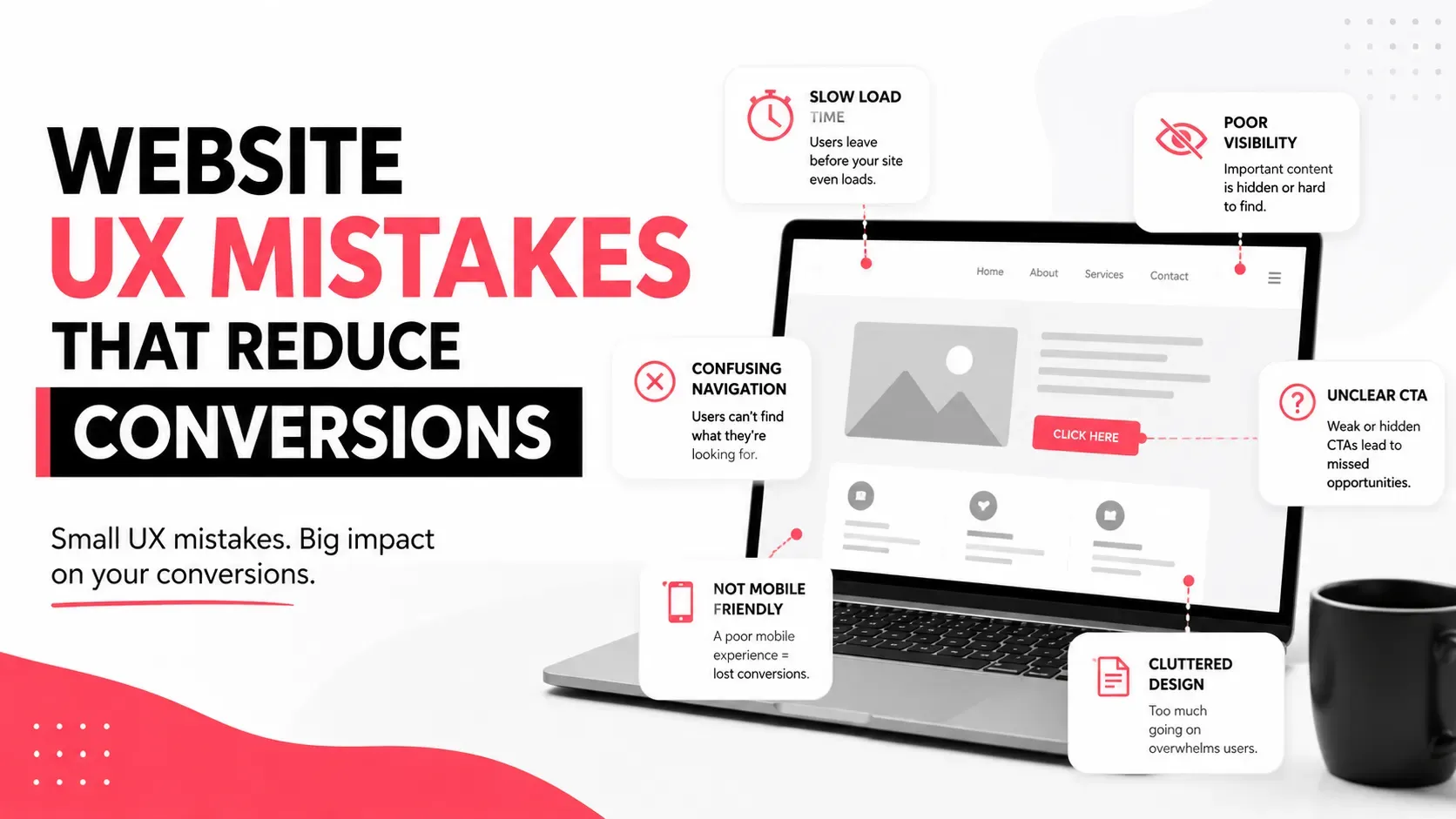
Many businesses assume that if people visit their website, conversions will naturally follow.
Unfortunately, that is rarely the case.
A website can generate significant traffic through SEO, social media, Google Ads, or email marketing and still fail to produce leads, inquiries, or sales.
In many situations, the problem is not traffic.
The problem is user experience (UX).
Poor UX creates friction throughout the customer journey, causing visitors to leave before completing important actions such as:
- submitting a contact form
- requesting a quote
- making a purchase
- booking a consultation
- calling the business
Even small UX mistakes can have a major impact on conversion rates.
This guide explores the most common website UX mistakes that reduce conversions and explains how UAE businesses can create a smoother, more profitable user experience.
Quick Answer
The most common UX mistakes that reduce conversions include:
- confusing navigation
- slow website speed
- poor mobile experience
- weak calls-to-action
- cluttered layouts
- complicated forms
- lack of trust signals
- unclear messaging
Businesses that eliminate these friction points often experience higher engagement, stronger lead generation, and better conversion rates.
Why UX Directly Impacts Conversions
User experience affects every interaction visitors have with your website.
If users struggle to:
- find information
- navigate pages
- understand services
- trust the business
- complete actions
they are far less likely to convert.
Good UX removes obstacles and helps visitors achieve their goals quickly and confidently.
How UX and Conversions Are Connected
The relationship is simple:
Better UX | Business Impact |
|---|---|
Easier navigation | More page views |
Faster loading | Lower bounce rates |
Clear messaging | Higher engagement |
Strong CTAs | More leads |
Better forms | Increased inquiries |
Mobile optimization | Higher conversion rates |
Improving UX often increases conversions without increasing traffic.
1. Confusing Navigation
Navigation is one of the most important parts of any website.
Visitors should immediately understand:
- where they are
- what you offer
- where to go next
Common Navigation Problems
- overcrowded menus
- unclear labels
- too many dropdowns
- inconsistent structure
- hidden important pages
Better Approach
Poor Navigation | Better Navigation |
|---|---|
15+ menu items | 5–7 core menu items |
Generic labels | Descriptive labels |
Complex dropdowns | Simple hierarchy |
Multiple pathways | Clear user journey |
The easier your website is to navigate, the more likely visitors are to convert.
2. Slow Website Speed
Users expect websites to load quickly.
Research consistently shows that conversion rates decline as loading times increase.
Common Speed Issues
- oversized images
- excessive scripts
- poor hosting
- unoptimized code
- too many plugins
Load Time | Typical User Behavior |
|---|---|
Under 2 seconds | High engagement |
2–4 seconds | Moderate engagement |
Over 4 seconds | Increased abandonment |
Website speed directly influences both UX and SEO.
Businesses looking to improve website performance can also explore our Web Development Services Dubai for speed optimization, UX improvements, and conversion-focused website development.
3. Poor Mobile Experience
Most UAE website traffic now comes from mobile devices.
Yet many websites are still designed primarily for desktop users.
Common Mobile UX Problems
- small text
- difficult navigation
- tiny buttons
- broken layouts
- slow mobile speed
Mobile UX Essentials
Requirement | Why It Matters |
|---|---|
Responsive design | Adapts to all screens |
Fast loading | Reduces abandonment |
Touch-friendly buttons | Improves usability |
Readable typography | Better engagement |
Simple forms | Higher completion rates |
Mobile UX is no longer optional.
4. Weak Calls-to-Action (CTAs)
Many businesses fail to guide users toward the next step.
Examples of weak CTAs include:
- Learn More
- Click Here
- Submit
These provide little motivation.
Strong CTA Examples
Weak CTA | Better CTA |
|---|---|
Submit | Get Your Free Quote |
Learn More | Speak With Our Team |
Contact Us | Request a Consultation |
Click Here | Start Your Project Today |
Clear CTAs improve conversion opportunities.
5. Cluttered Page Layouts
Trying to display everything at once often overwhelms visitors.
Common problems include:
- too much text
- excessive banners
- multiple CTAs
- crowded sections
- visual distractions
Good UX prioritizes clarity over quantity.
A clean design helps visitors focus on important actions.
6. Unclear Value Proposition
Visitors should understand within seconds:
- what you offer
- who you help
- why they should choose you
Weak Messaging Example
"We provide innovative business solutions."
Strong Messaging Example
"Custom web development and digital marketing solutions for businesses in Dubai."
Specific messaging converts better than vague statements.
7. Complicated Contact Forms
Long forms create friction.
Every additional field can reduce completion rates.
Form Optimization Checklist
Avoid | Prefer |
|---|---|
12+ fields | 4–6 essential fields |
Unnecessary questions | Simple information requests |
Multiple steps | Short forms |
Complex layouts | Clear structure |
Simpler forms usually generate more leads.
8. Lack of Trust Signals
Visitors need reassurance before taking action.
Trust signals help reduce uncertainty.
Effective Trust Signals
- testimonials
- client reviews
- case studies
- certifications
- awards
- portfolio examples
Trust directly influences conversion decisions.
9. Poor Readability
Many websites make content difficult to consume.
Common Problems
- large text blocks
- small fonts
- poor spacing
- weak contrast
- inconsistent formatting
Better Content Structure
- short paragraphs
- headings
- bullet points
- tables
- visual hierarchy
Readable content keeps visitors engaged longer.
10. Too Many Conversion Paths
Some websites overwhelm users with options.
Examples include:
- multiple primary CTAs
- competing offers
- conflicting messages
Every page should have one primary objective.
Clarity generally improves conversions.
11. Missing Social Proof
Social proof influences trust and decision-making.
Examples include:
- client testimonials
- ratings
- reviews
- success stories
- case studies
Users often look for validation before contacting a business.
12. Poor Landing Page Experience
Many businesses send paid traffic to generic pages.
Landing pages should align closely with:
- user intent
- ad messaging
- customer expectations
High-Converting Landing Pages Usually Include
- clear headline
- strong value proposition
- trust signals
- focused CTA
- minimal distractions
Landing page optimization can significantly improve conversion rates.
You can also read our Landing Page Optimization for Higher Conversions to learn how better page design improves lead generation and sales performance.
13. Ignoring User Behavior Data
Many businesses redesign websites based on assumptions.
Instead, UX decisions should be informed by:
- analytics
- heatmaps
- session recordings
- user testing
- conversion tracking
Data-driven improvements typically produce better results.
Most Common UX Conversion Killers
UX Mistake | Impact on Conversions |
|---|---|
Slow website | High bounce rates |
Poor mobile experience | Lost mobile leads |
Weak CTAs | Lower inquiries |
Complex forms | Fewer submissions |
Confusing navigation | User frustration |
Missing trust signals | Reduced credibility |
Cluttered layouts | Lower engagement |
Unclear messaging | Visitor confusion |
Key Takeaways
- UX directly affects lead generation and sales
- Website speed influences user behavior
- Mobile usability is critical
- Strong CTAs improve conversions
- Simple navigation enhances engagement
- Trust signals build credibility
- Better forms increase lead submissions
- Data-driven UX improvements produce stronger results
What Actually Works in 2026
The highest-converting business websites focus on:
- simplicity
- clarity
- speed
- trust
- mobile usability
- conversion-focused design
- data-driven optimization
The best UX experiences remove friction and help visitors complete actions effortlessly.
Bringing It All Together
Website UX mistakes often go unnoticed because businesses focus heavily on traffic generation rather than user experience.
However, even the best SEO and advertising campaigns can underperform if the website creates unnecessary friction.
The businesses achieving the strongest conversion rates today prioritize:
- intuitive navigation
- fast performance
- mobile-first experiences
- clear messaging
- trust-building elements
- conversion optimization
From service businesses and startups to ecommerce stores and enterprise organizations, improving UX often produces one of the highest returns on investment in digital marketing.
Milaaj Brandset helps businesses create conversion-focused websites that combine UX best practices, SEO performance, and measurable business growth.
FAQs
What is UX in web design?
UX (User Experience) refers to how users interact with and experience a website, including usability, navigation, accessibility, and satisfaction.
How does UX affect conversions?
Good UX reduces friction, improves trust, and helps users complete desired actions more easily.
What is the biggest UX mistake businesses make?
Poor navigation and unclear calls-to-action are among the most common conversion-reducing UX mistakes.
Why is mobile UX important?
Most users browse websites on mobile devices, making mobile usability critical for engagement and conversions.
Do slow websites reduce conversions?
Yes. Slow-loading websites often experience higher bounce rates and lower conversion rates.
How many fields should a contact form have?
Most high-converting forms contain only the essential fields required to start a conversation.
What are trust signals?
Trust signals include reviews, testimonials, certifications, case studies, awards, and client logos that increase credibility.
Can UX improvements increase sales without increasing traffic?
Yes. Improving UX often boosts conversion rates, allowing businesses to generate more leads and sales from existing traffic.
Ready to Elevate Your Brand?
Start Your Project Today